Discover Poole’s Mill Park: Covered Bridge & Sliding Rocks
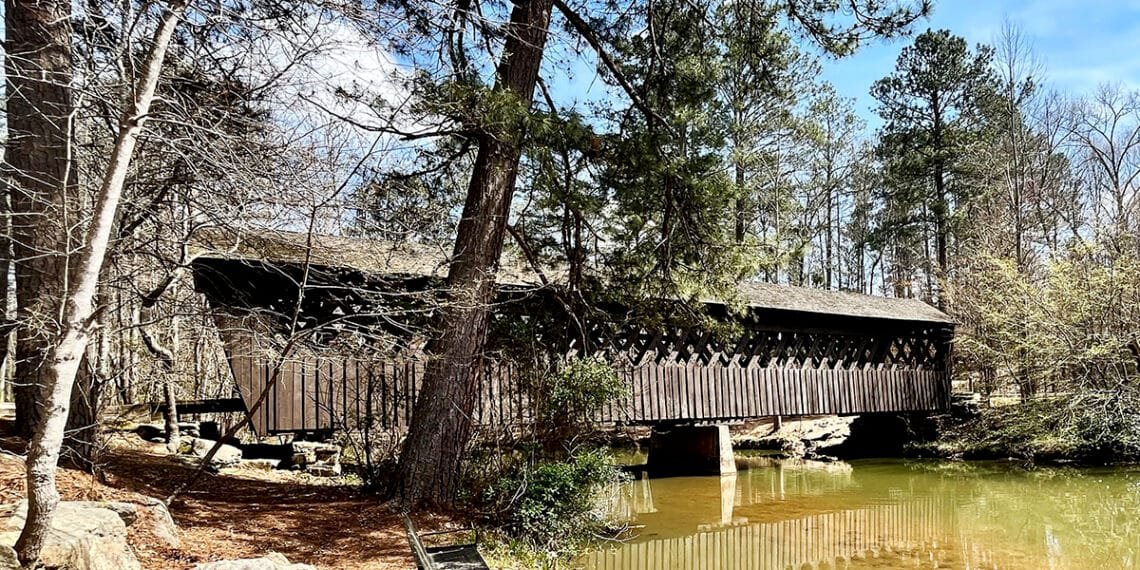
Poole’s Mill Park is an excellent Forsyth County Park with a Ball Ground, Georgia address. The metro Atlanta park features a playground for families. You will find a covered picnic pavilion with tables and restrooms between the playground and Settendown Creek. A historic covered bridge spans the creek. This bridge is an Insta-worthy photo location in addition to a window into the past. Cross the bridge and, explore the creek and its natural water slides!
Historic Poole’s Mill Covered Bridge
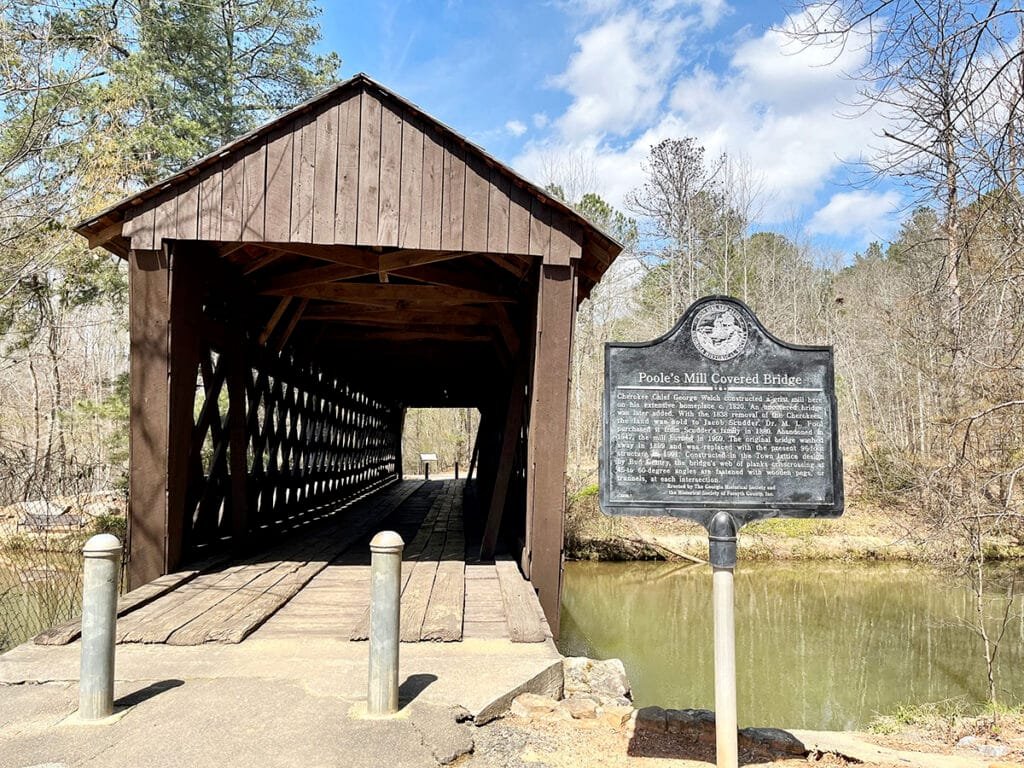
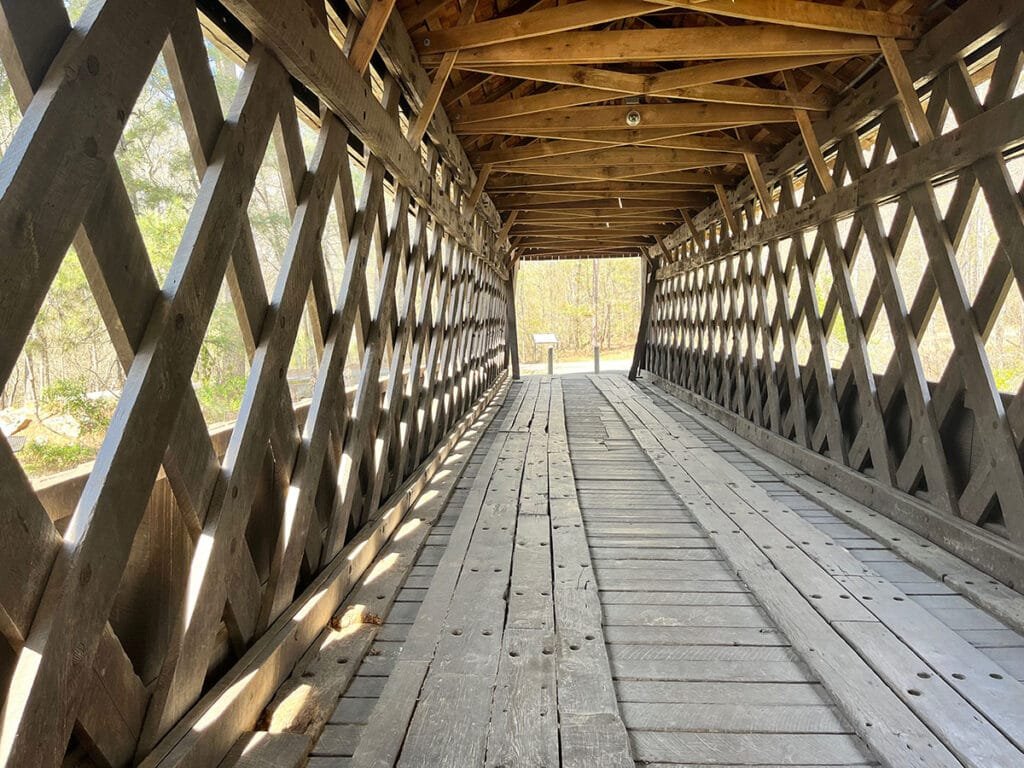
Poole’s Mill Bridge is a historic covered timber bridge was built in 1901. Roofs on historic bridges protect the surface of the bridge from weather and deterioration. Covering a bridge extends its lifespan by roughly 80-years. Covered bridges typically last close to 100-years. This 96-foot long, single lane bridge crosses Settendown Creek, which feeds into the Etowah River. The bridge is built in the lattice truss style allowing for the use of smaller planks. This construction style made the bridge easier and less expensive to build.
Most covered bridges in the United States were built between the late 18th century and the late 19th century. The current Poole’s Mill Bridge was built to replace the previous bridge, which was destroyed by a flood in 1899. Dr. Poole’s great-grandson shared the story that the carpenter, John Wofford, commenced construction of the bridge, however he initially bored the holes for the pegs in the wrong locations. He responded to the situation by leaving town!
The more responsible carpenter, Bud Gentry, took over the project, boring the holes in the correct location and finishing the project. Notice the wooden pegs used to fasten the wood planks and the extra holes! Boards that had too many holes in the wrong location became treads protecting the bridge from wear and tear from wheels.
History of Poole’s Mill
Chief George Welch & the Cherokee Nation
George Welch, who was a Cherokee Chief occupied this land at the beginning of the 19th century. He built a homestead that included a sawmill, a gristmill and a basic uncovered bridge over the creek. He witnessed the 1830 Indian Removal Act which confiscated land from the Cherokee people. Based on this experience, Chief Welch decided that it was safer for the Cherokee Nation to move and be compensated for their land rather than be forcibly driven away from their home without any compensation.
Chief Welch signed the amended New Echota Treaty in March 1836 in Washington DC. This treaty granted him US citizenship, but it also resulted in the Cherokee Removal in 1838. Cherokee who did not agree murdered many Cherokee leaders who signed the treaty. Records indicate that Chief Welch died in a logging accident in Georgia 1840. Chief Major Ridge was Welch’s contemporary who shared his opinion and also signed the treaty. Other members of the Cherokee Nation murdered him on the Trail of Tears. You can visit Major Ridge’s home at the Chieftan’s Museum in Rome, Georgia.
The Land Lottery of 1832
The State of Georgia redistributed confiscated Cherokee land through a land lottery in 1832. John Maynard of Jackson County, Georgia won Chief Welch’s property. In 1933, he sold it to Jacob Scudder, a white man married to Chief Welch’s wife’s sister. Scudder operated the mill and maintained the bridge until he died in 1870. At that point Dr. M. L. Poole purchased the land and added a cotton gin to the complex around 1920. Due to the prevalence of electricity in 1947, the mills stopped operating. Vandals destroyed the mills with fire in 1959.
The Birth of Poole’s Mill Park
By the 1980s the bridge fell into disrepair. Luckily a group of private citizens took interest in the site. In the 1990s, they added a concrete structural support to the mid-span of the bridge and donated the land in the area to Forsyth County to create Poole’s Mill Park, which opened in 1997.
Today, the bridge is a wonderful place to explore and discover the past. It makes an excellent location for personal or professional photo shoots.
The National Historic Register of Historic Places lists the bridge.
Poole’s Mill Park Playground and Pavilion
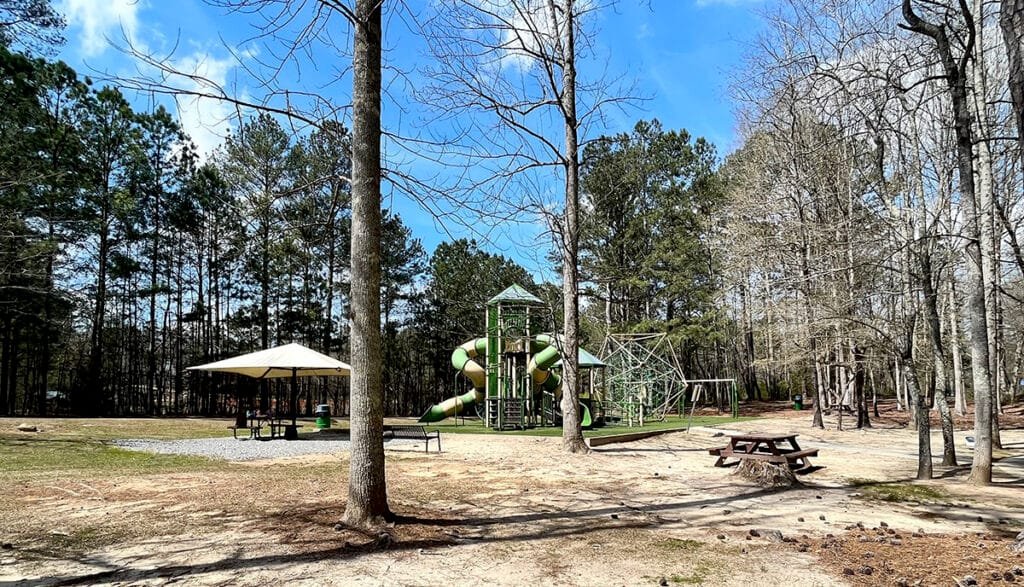
This metro Atlanta Forsyth County Park offers plenty of free parking for visitors. The playground, built in 2020, is located close to the parking lot. It includes includes a really fun spiderweb like structure and a climbing structure with covered twisty slides. Children between the ages of 5 and 12 years old will enjoy the playground the most. There is only one shade structure near the playground, so it may be better to avoid the middle of the day during the summer.
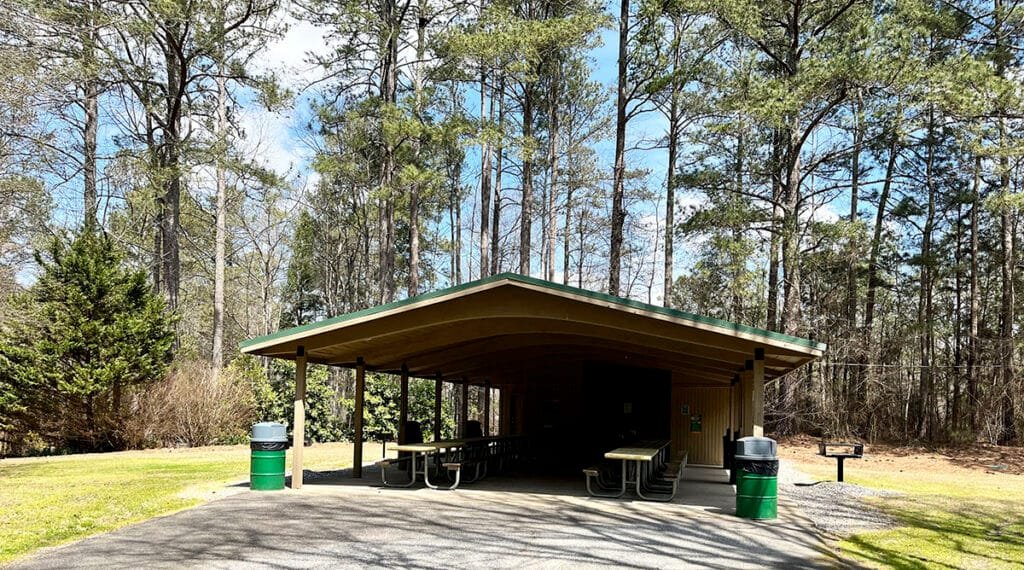
On the way to the Covered Bridge, you will find a large covered Picnic Pavilion that includes picnic tables. restrooms and water fountains are available during the warmer months. They are typically closed from early fall until early spring. The pavilion includes grills and a few electrical outlets is available to rent through Forsyth County.
There are a few short walking trails within the 10-acre park and some additional picnic tables along Settendown Creek.
Settendown Creek & the Sliding Rocks
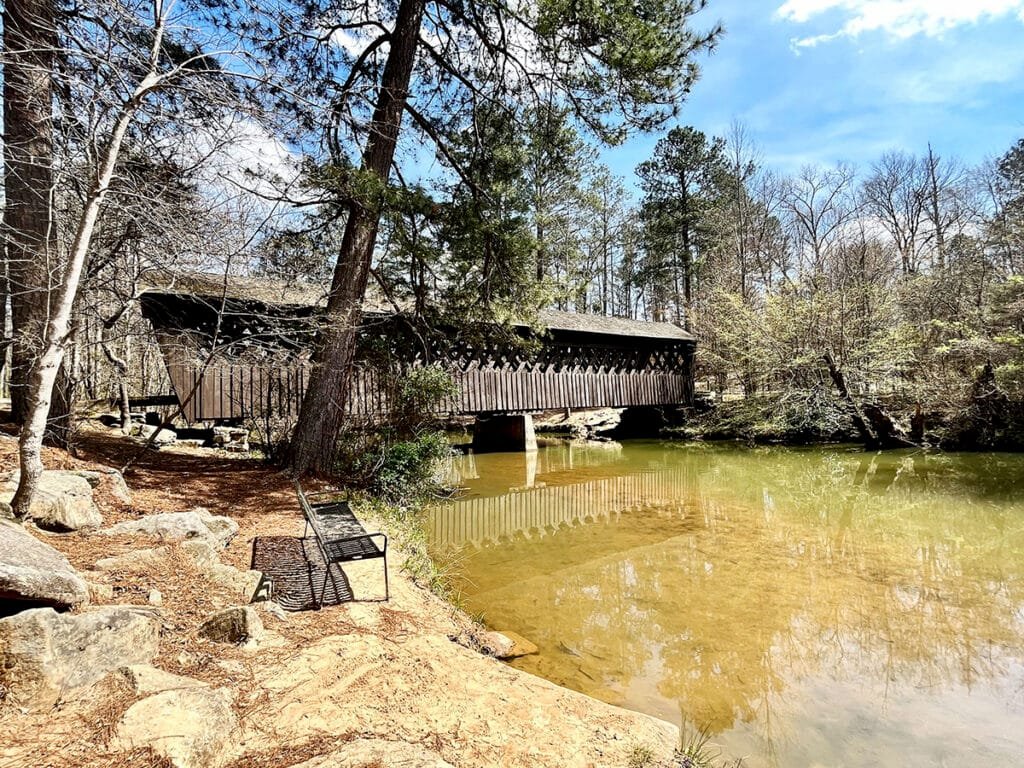
The creek is a little deeper near the bridge and the water moves a little bit more quickly just before it made the bend and started downhill. We saw an older child with a tube here. We crossed over the historic bridge and walked along the creek, which was beautiful. Further down the hill, the creek bed creates a natural water slide. The path to this location was a little muddy and slippery, so use caution! We saw a family with small children taking turns sliding down the relatively short stretch of gently sloping rock, which deposited the children in a shallow pool of water.
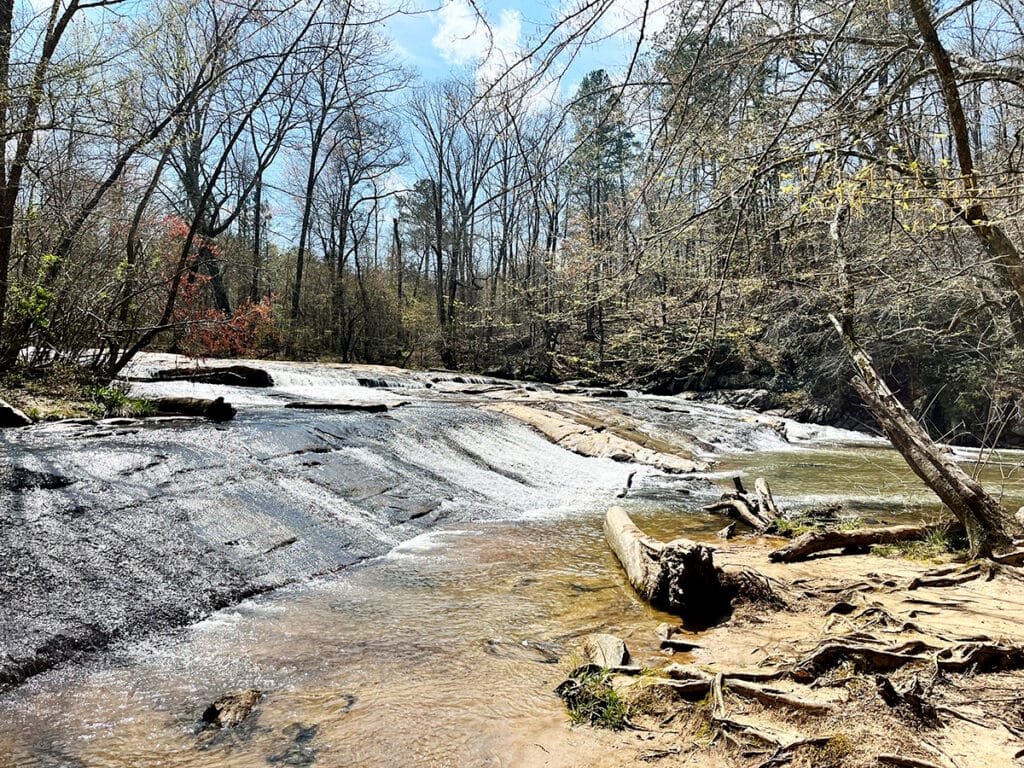
The property line of the park ends abruptly past this pool of water. A fence across the creek marks the property line. Pay attention to make sure that you do not cross onto private property! If you come for some fun in the water on a hot day, bring water shoes to protect your feet!
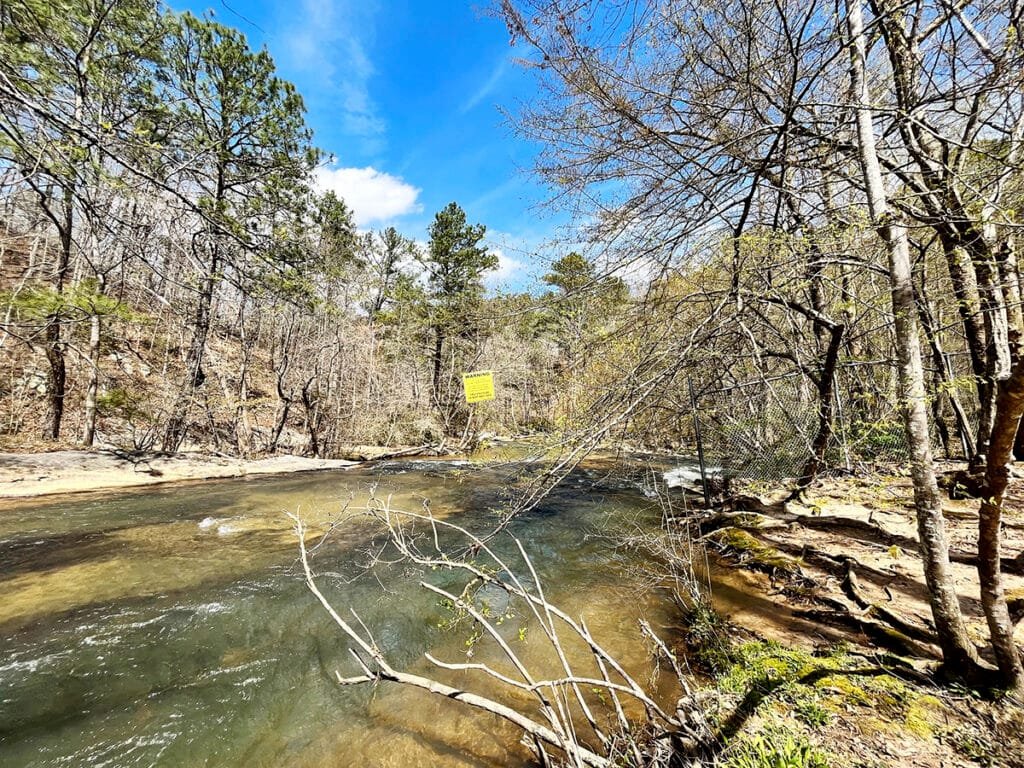
If you want to tube, you should bring a tube with a bottom. You could ride your tube down the further side of the creek, where the water was a little bit faster. This is a natural waterway, so use caution and make sure that the conditions are safe and the water is not too deep or moving too fast prior to entering the water. The stretch of creek in the park is relatively short, so expect to climb back up to the top and complete a series of runs rather than a single, long run.
Enjoying Poole’s Mill Park
This is an excellent metro Atlanta park to visit at any time of year. Families will enjoy the playground at any time of year. History buffs and photographers will love historic Poole’s Mill Covered Bridge and Settendown Creek running below it. In warmer months, enjoy the Picnic Pavilion, and cooling off in the creek.
Have you visited Poole’s Mill Park before? Let me know your favorite thing to do there in the comments!


You May Also Like
Atlanta: Inman Park Neighborhood Guide
Mercedes-Benz Stadium & State Farm Arena: A Local Guide for Concerts & Games